You’ve probably been there: a student reads aloud beautifully – every word pronounced perfectly, pace right on point – but when you ask what the text was about, they shrug. Or guess. Or say something completely unrelated.
Teaching reading comprehension, especially in 2nd and 3rd grade, is like trying to build a bridge while the river is rising. Your students are moving from learning to read to reading to learn, and that leap is bigger than it looks.
Understanding how to teach reading comprehension involves recognizing these challenges and implementing effective strategies.
This post is your go-to guide for how to teach reading comprehension in 2nd and 3rd grade using strategies that work with any text, fiction, nonfiction, you name it.
✨ Bonus: There’s a free sample of my Reading Comprehension Strategies Mini Books waiting for you, too.
Why Is Reading Comprehension So Hard to Teach?
If you’re wondering how to teach reading comprehension without pulling your hair out, you’re not alone. Here are just a few common frustrations about how to teach reading comprehension effectively:
- Students who decode fluently but don’t understand the meaning
- Comprehension skills taught in isolation that don’t transfer to independent reading
- Not enough time to teach reading strategies in depth
- Lack of consistency across texts and genres
On top of that, comprehension isn’t a one-and-done skill. It requires repetition, modeling, and opportunities for reflection and revision. Without a strong foundation of strategies and a repeatable framework, students often revert to surface-level responses, such as “I liked it” or “It was about a dog.”
Spoiler alert: it doesn’t have to be this way.
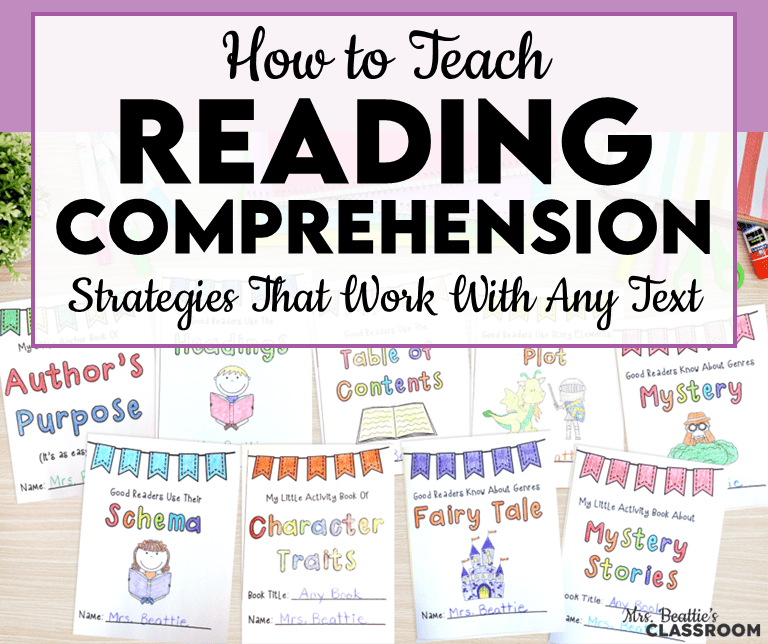
🎯 Grab a FREE sample of the Reading Comprehension Strategies Mini Books here to try these strategies with your students tomorrow. No prep required! These printable and digital mini-books are strategy-based activity booklets you can pair with any text you’re already using!
How to Teach Reading Comprehension in 2nd and 3rd Grade (Without Reinventing the Wheel)
Let’s look at six core ideas that make teaching comprehension less chaotic, and much more effective. These strategies are designed to be flexible, so they can be used with any text: picture books, articles, read-alouds, even test-prep passages. These approaches work beautifully with any text, but they shine especially well when paired with the 120+ printable and digital mini-books in my Reading Comprehension Mini Book bundle.
Each mini-book is short, purposeful, and designed to support one or more reading comprehension strategies. And because they’re available in printable and Google Slides formats, you can use them for whole-group, small-group, centers, or even independent reading.
1. Start with a Before-During-After Framework
Reading comprehension starts before students even begin reading. To build strong understanding, teach students to engage with the text in three phases:
Before Reading:
- Activate prior knowledge (KWL charts work great)
- Preview titles, headings, and visuals
- Set a purpose for reading
- Make predictions based on the genre and text features
During Reading:
- Ask and answer questions while reading
- Visualize scenes and events
- Monitor for understanding and stop when something doesn’t make sense
- Mark evidence or key ideas with sticky notes or symbols
After Reading:
- Summarize the main idea
- Make text connections (text-to-self, text-to-text, text-to-world)
- Reflect on author’s purpose or point of view
- Share personal reactions and deeper interpretations
🎯 Tip: Use the same text over two or three days, focusing on a different reading strategy each time. Then pair the text with a mini-book that matches the day’s strategy (like “Making Predictions” or “Asking Questions”) to reinforce the skill through writing, drawing, and reflection.
2. Explicitly Teach Reading Comprehension Strategies One at a Time
When thinking about how to teach reading comprehension, one of the most effective things you can do is to slow it down. Introduce strategies one at a time, and give students multiple opportunities to practice them with different texts.
Some essential reading comprehension strategies include:
- Visualizing (making mental images while reading)
- Asking questions (who, what, why, how)
- Making predictions (before and during)
- Making connections (to themselves, other texts, or the world)
- Summarizing (identifying the most important ideas)
- Inferring (reading between the lines)
Guide students through your thought process step by step. Then, use guided practice to let them try the strategy with support. For example, you could read a picture book or article aloud, then think aloud to model your use of the strategy:
“I’m wondering why the character is acting this way… that’s a good question to ask while reading.”
Afterward, choose a mini-book that focuses on that strategy. Students write or draw responses, practice using the strategy, and apply it to whatever they’re reading in class.

3. Apply Strategies Across Fiction and Nonfiction
Too often, comprehension instruction is focused mostly on stories. But in real life, and standardized testing, students need to read and understand a wide range of nonfiction as well.
Here’s how to adapt strategies across genres:
- In fiction, students might visualize the setting or character actions.
- In nonfiction, they might visualize a process (like photosynthesis or how a volcano erupts).
- In fiction, they summarize by identifying the problem and solution.
- In nonfiction, they summarize key facts or steps in a process.
🎯 Tip: Try using paired texts with similar themes but different genres. For example, read “The Snowy Day” and pair it with a nonfiction passage about weather or snow science. Students can use the same comprehension strategy for both. This not only deepens comprehension, it makes it easier for students to apply strategies when standardized tests or assessments roll around.
4. Model, Model, Model (Then Release Responsibility)
Students don’t automatically know how to monitor comprehension. They need to hear you use the strategy as a reader.
Use daily think-alouds like:
- “I didn’t understand that part, so I’m going to reread the last sentence.”
- “This reminds me of another story we read…”
- “I’m predicting that the character will solve the problem by…”
- “This word doesn’t make sense to me. I’m going to reread the last paragraph to clarify.”
- “I wonder why the author chose to end the article this way…”
Once students hear your thought process, they’re better equipped to try it themselves. Then assign a matching mini-book activity for practice.
The mini-books make it easy to reinforce the strategy right after a whole-group lesson. Each one includes strategy-based activities students can complete independently or with partners.

5. Reflect and Revisit Reading Comprehension Strategies Often
Teaching reading comprehension isn’t a “set it and forget it” situation. Students need to revisit strategies regularly and reflect on what worked for them. Want to turn strategies into habits? Reflection is the magic ingredient.
Ask your students:
- What strategy did you use today?
- How did it help you understand the story or article?
- Did you reread when something didn’t make sense?
- What was challenging about this text?
- Would you use it again next time?
The free sample of the resource includes print-and-go mini-books with space for exactly this kind of strategy reflection with no extra planning required.
6. Differentiate Reading Comprehension Instruction for Every Reader
Your class is full of unique learners, and instruction on comprehension strategies should reflect that. With over 120 mini-books available, you have an incredible toolbox for differentiation without having to prep multiple resources.
Struggling readers might need:
- Just one strategy to focus on at a time
- More time spent on practicing the strategy with support
- Visual reminders (charts, icons, color coding)
- Predictable texts and scaffolding with sentence starters
Advanced readers might benefit from:
- Multiple strategy choices per text (e.g., visualize and summarize)
- Independent application
- Apply to chapter books or nonfiction text sets
Every mini-book is available as both a printable version and a digital Google Slides version, making it perfect for centers, small groups, homework, or virtual learning. The digital slides are also perfect for whole-class instruction!
Teacher Feedback
Here are just a few of the more than 300 positive 5-star reviews on this resource on TPT:
“I loved that I could pair the resource with texts of my choosing, allowing for flexibility in my lessons.”
“I love using the digital slides for mini lessons and the mini books are great for reader’s workshop activities.”
“Love being able to use the open ended booklets to reinforce lessons with students’ independent reading books.”
🎯 Ready to teach reading comprehension with more confidence (and less prep)? Snag the free sample of the Reading Comprehension Strategies Mini-Books.
You’ll get:
- A free set of print AND digital mini-books
- Strategy-focused comprehension tasks
- Prompts and activities that work with any text
Perfect for small groups, centers, or whole group response!
Reading Comprehension Doesn’t Have to Be a Mystery
Now that you know how to teach reading comprehension using flexible, proven strategies, you’ve got everything you need to boost your students’ understanding without burning yourself out.
How to Teach Reading Comprehension Like a Pro Checklist Recap:
- Use the before-during-after model
- Explicitly teach comprehension strategies
- Apply strategies to fiction and nonfiction
- Model your thinking daily
- Revisit and reflect regularly
- Differentiate support for all learners
With consistent practice and the right tools, your students won’t just read, they’ll understand. And you’ll spend way less time wondering if it “stuck.”
Don’t forget to grab your free sample today and take the first step toward easier, more effective comprehension instruction.
You can also grab the complete bundle with 120+ printable reading comprehension strategies mini books, and 120+ digital slides right here:

You might also be interested in the ideas I’ve shared in this post:
If you have enjoyed this post, please share it with friends and colleagues on Facebook or pin it on Pinterest: